

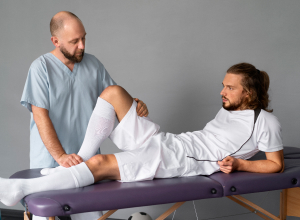

Restless leg syndrome is characterized by a powerful, irresistible urge to move one's legs. It is also known as Wittmaack-Ekbom's syndrome. Many unpleasant sensations like burning, aching, or bugs creeping, crawling, tugging, etc. in the legs make the person want to move them constantly. These sensations are strongest when the person relaxes his legs, lies down, or sits. They can be intense enough to make the person unusually irritable and disturbs many a good night’s sleep.
RLS can affect men, women, and children. It is less common in persons below 20 years. Pregnancy is also known to cause RLS though how is unclear. Usually, it appears in the last trimester of pregnancy and disappears after delivery. Persons of North European descent are more likely to develop RLS. The French-Canadian populations are also more prone to RLS. RLS before 20 years is usually of a genetic origin. There is a strong history of close relatives (parents or siblings) suffering from the same.
Many diseases and conditions can trigger RLS in vulnerable persons, while some conditions worsen the severity of RLS in sufferers:
Whenever the cause of RLS can be ascertained, it is called secondary RLS. The condition is termed secondary RLS when there is no appreciable cause. These persons usually have a genetic tendency to RLS. Scientists today believe that RLS can occur within families as an autosomal dominant trait. These persons develop the symptoms at an earlier age (less than 20 years).
Primarily, RLS is thought of as a sensory disorder. Persons use many descriptive terms to explain the vague, indistinct sensations they feel. Often the same person may suffer from multiple types of sensations.
However, one common line running through all types of sensations is the irresistible, overwhelming impulse to keep moving one's legs.
US-Canada: +1-315-351-0898
What your doctor wont tell you about homeopathy?
What doctors should know about Homeopathy?
How to find a good homeopath?
Integration of Homeopathy with Conventional medicine
Frequently asked questions compiled from the source disease page.
RLS can affect men, women, and children. It is less common in persons below 20 years. Pregnancy is also known to cause RLS though how is unclear. Usually, it appears in the last trimester of pregnancy and disappears after delivery. Persons of North European descent are more likely to develop RLS. The French-Canadian populations are also more prone to RLS. RLS before 20 years is usually of a genetic origin. There is a strong history of close relatives (parents or siblings) suffering from the same.
The National Institute of Health (NIH) has provided the diagnostic criteria. Persons are diagnosed as suffering from RLS when the following are present:
2026 Copyright reserved.
Contact our clinic for appointments, follow-ups, and treatment guidance.
Monday: 5:30 PM - 9:30 PM
Tuesday: 5:30 PM - 9:30 PM
Wednesday: 5:30 PM - 9:30 PM
Thursday: 5:30 PM - 9:30 PM
Friday: 5:30 PM - 9:30 PM
Saturday: 5:30 PM - 9:30 PM
Sunday: Closed



Your cart is currently empty